“How often should windows be adjusted?” is a common service question. Guides often repeat answers such as “once a year”, “every two years” or “in spring and autumn”. Those intervals are only simplifications. The need for adjustment depends on the specific window, the hardware system and how the window actually behaves in everyday use.
The date of the last service does not by itself tell you whether a window needs adjustment. What matters more is how it operates and whether specific symptoms have appeared.
Why a universal schedule is only a shortcut
Different hardware systems may have different maintenance requirements. If the manufacturer of a particular window or hardware system provides maintenance or inspection guidance, it is worth referring to it.
How the window is used also matters, as does any change in the way it operates. A window opened only occasionally and one used many times a day are not working under identical conditions.
When does a window actually need adjustment?
A more useful question than “when should I schedule adjustment?” is “what tells me the window should be checked?”. Pay particular attention to:
— a handle that has started to require noticeably more force,
— a sash rubbing against the frame or becoming harder to close,
— a draught felt with the window closed,
— visible damage or deformation of a seal,
— rubbing marks on the profile or frame.
Each of these is a reason to inspect the window more closely. The symptom itself does not determine the solution: handle resistance, a draught or a rubbing mark can have different causes.
Whether the window needs sash adjustment, maintenance, seal replacement or repair of a hardware component depends on what is actually causing the problem.
If the window operates correctly and there are no symptoms pointing to a need for adjustment, the passage of a certain amount of time is not, on its own, a reason to change hardware settings.
“Winter mode” and “summer mode” — when does this type of adjustment make sense?
Seasonal compression adjustment is sometimes presented as a universal rule for PVC windows. In reality, not every hardware system provides for this type of adjustment, and even where compression can be changed, that does not mean it should be altered every time the season changes.
If a new symptom appears as conditions change — for example, a draught or more difficult closing — the cause should be identified first. It does not automatically mean the window needs to be switched into a “winter” or “summer” mode. The issue may involve sash position, compression, sealing or another component.
The season may coincide with a symptom appearing. It is not a diagnosis.
Lubrication and adjustment are different tasks
Lubrication and adjustment are not the same thing. Maintenance may include lubricating accessible moving hardware components with an appropriate product. Adjustment, on the other hand, concerns sash position and the operation of the elements responsible for closing and locking.
Lubrication will not correct incorrect sash alignment, while adjustment does not replace maintenance where a component actually requires it.
Incorrect adjustment can change the way a window closes or compresses against the seals and can make its operation worse. Without knowing the specific hardware system, it is better not to change settings by trial and error.
Not every general-purpose spray is intended for periodic window-hardware maintenance. Before using a product, check its intended application and the guidance for the specific hardware system.
What does a professional window inspection include?
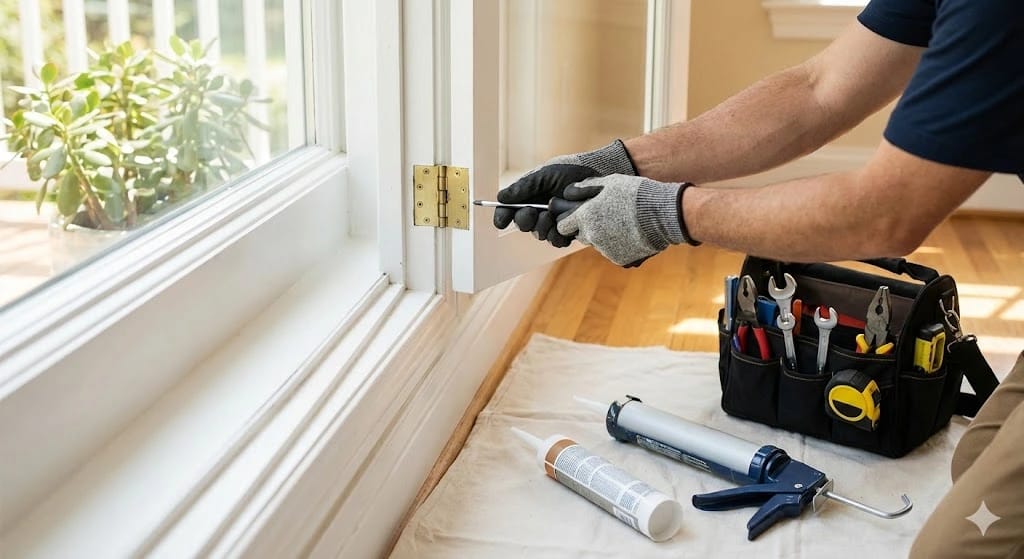
During an inspection, a technician first checks how the window opens, closes and locks. Accessible hardware components and seals are assessed, with attention to points where resistance, rubbing or leakage appears.
Not every window will require the same work. If the problem comes from sash position, adjustment may be needed. If the cause is a worn or damaged component, the next step depends on its condition and whether it can be repaired or replaced.
As part of a window service, we first identify the cause of the problem and then explain the required work and its cost before repair begins.
So when is it worth checking your windows?
You do not need to wait for a particular month or automatically adjust windows every year. Instead, watch for changes in how they operate: more resistance at the handle, sash rubbing, harder closing, a new draught or visible seal damage.
If the window works correctly, the calendar alone is not a reason to alter its settings. If a specific symptom appears, identify its cause rather than adjusting the window “just in case”.
Good adjustment responds to a specific problem, not a date on the calendar. More information about the service is available on our window adjustment page.
Related content and services
Regular checks help catch changes early. Typical scope includes window adjustment, gasket replacement or cleaning and lubrication of the hardware. We service windows in Warsaw, Krakow, Katowice and Wroclaw. Initial diagnosis and travel are free of charge.
There is no single universal frequency of window adjustment that fits every design and every flat. What matters is the hardware manufacturer's recommendation, how intensively the window is used, its exposure to external conditions and its previous maintenance history. Two windows in the same building may need very different service intervals.
The practical criterion is not "every X years" but rather: does the window still work as before. A stiffer handle, clearly greater sash resistance, a draught with the window closed or difficulty closing are all signals that inspection is worth scheduling without waiting for the next season. Adjustment done at the right time is usually enough for the window to return to correct operation without replacing components.