A window that starts rubbing against the frame, closes unevenly or changes the way it operates when closing does not always need hardware replacement. If the mechanism is sound, correcting sash position or settings that affect its interaction with the frame may be enough.
There is no single adjustment procedure that fits every PVC window. Adjustment-point locations, correction direction, movement range and required tools depend on the hardware system. Before making changes, identify the symptom and the mechanism fitted to the particular window.
When might a window need adjustment?
Adjustment is worth considering when sash position or operation has changed and there is no visible hardware damage. The location and character of the symptom are the most useful starting points.
| Symptom | What to check before adjustment |
|---|
| The sash rubs along the lower edge | Sash position relative to the lower frame and closing components. |
| The sash rubs at the side | Side-to-side sash position relative to the frame. |
| The handle has become harder to operate | Whether the sash interacts correctly with the closing components and whether the mechanism is damaged. |
| Air movement is felt locally | Sash position and the condition of components responsible for airtightness. |
| The mechanism jams or has obvious play | Hardware condition before further adjustment. |
None of these symptoms proves on its own that adjustment is sufficient. Similar signs can also occur with damaged hardware, gasket problems or a leak outside the sash-to-frame contact.
What can be adjusted in a PVC window?
Depending on the hardware design, sash position and settings that affect closing and contact with the frame may be adjustable. Not every system provides these corrections in the same way, so the function of the adjusted component matters more than the name of a particular screw.
Vertical sash position
Vertical correction changes the height of the sash relative to the frame. It may be relevant when the sash starts rubbing against the lower part of the frame or its position has changed relative to the closing components.
Horizontal sash position
Horizontal correction changes the side-to-side position of the sash relative to the frame. It may be needed when the sash rubs at the side or its alignment with the frame and closing components has become uneven.
Sash compression against the frame
Some systems allow correction of settings that affect sash compression against the frame. This does not mean every airtightness problem should be solved by increasing compression. If the cause is the gasket, incorrect sash position or a leak outside the sash-to-frame contact, changing compression alone may not remove the problem.
Before adjusting — identify the hardware system
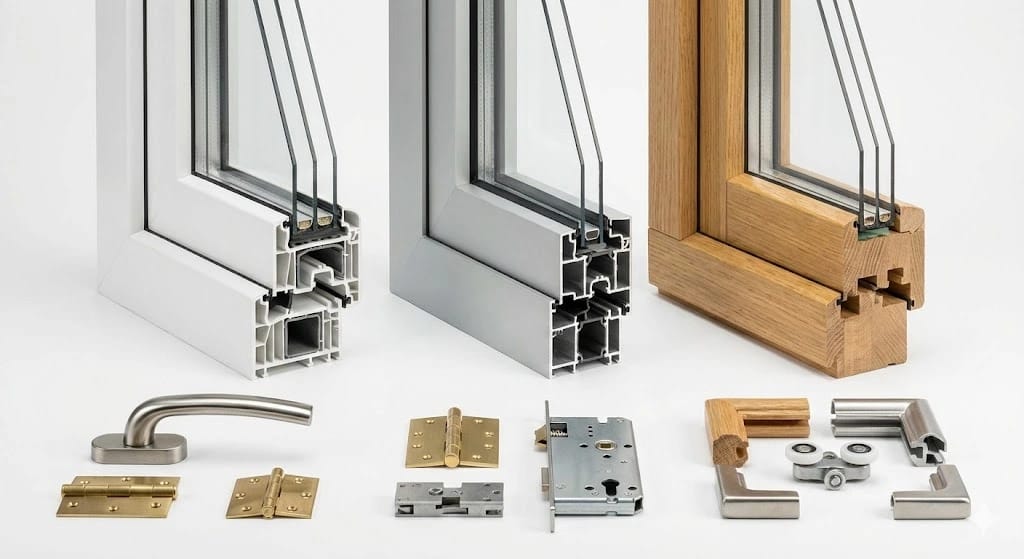
Hardware from different manufacturers can vary in adjustment-point location, correction direction, movement range and required tool. Instructions written for one system should not automatically be applied to another.
If the hardware shows a manufacturer name, series marking or another identifier, use it to check documentation for the relevant mechanism. This helps establish which component performs a particular correction and what adjustment range the manufacturer intended.
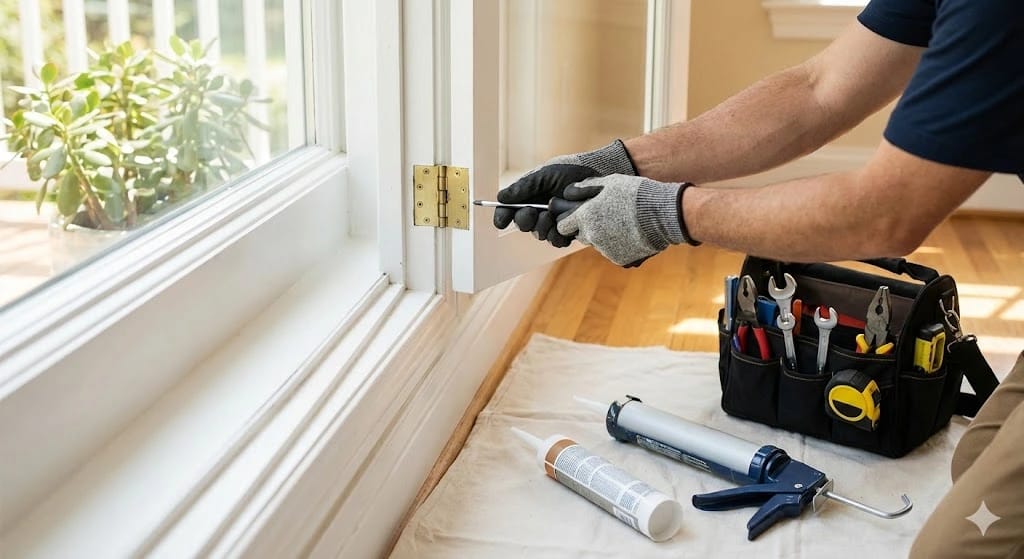
This also applies to window hinge adjustment. Depending on the system, some sash-position corrections are made on the hinge side, but not every hinge has the same adjustment points or performs the same correction. Do not turn a random component simply because an available tool fits it.
How can you adjust a window without making the setting worse?
Once the correct adjustment point has been identified, make small changes. After each correction, close and reopen the sash and check whether the problem has improved and whether rubbing, greater handle resistance or another new symptom has appeared.
Change only one parameter at a time. Adjusting several points simultaneously makes it difficult to tell which change produced the result and which one caused any deterioration.
Before starting, take a photo of the initial position of the adjustment element. This makes it easier to compare the setting before and after the correction.
Adjustment has a defined range for the particular mechanism. If achieving the correct position requires a large change, the regulator reaches the end of its range, or the component offers unusually high resistance, do not try to compensate by turning it further or applying more force.
Window compression adjustment — when can it help?
Correcting settings that affect compression may make sense when the problem genuinely concerns how the sash meets the frame and the closing mechanism and sealing components show no damage requiring another repair.
Increasing compression “just in case” is not a proper adjustment method. Excessive correction can increase closing resistance and change the way mechanism components interact. The aim is correct sash-to-frame operation, not the highest possible compression.
Seasonal compression settings are sometimes discussed online. They are not a universal feature of every window or hardware system. We cover the topic separately in our guide to window adjustment for winter and summer.
Window adjustment and gasket condition
Adjustment and gasket condition are separate parts of diagnosis. If an airtightness problem comes from gasket damage, incorrect seating or a leak outside the sash-to-frame contact, changing sash settings does not remove the source.
For a draught, separate two questions: is the sash positioned correctly, and are the components responsible for airtightness in suitable condition? We discuss this in more detail in our guide to a draught from a window — sealing or gasket replacement.
When should you stop adjustment and check the hardware?
Do not continue DIY attempts when the adjustment point cannot be identified clearly, a mechanism component is cracked, bent or loose, the sash has obvious play, or the mechanism jams and requires substantial force. It is also worth stopping if a small correction clearly makes window operation worse.
Adjustment and repair are not the same thing. Adjustment changes the setting of a sound mechanism within the range intended by its design. If a component itself is damaged, excessively loose or does not operate correctly, repair or replacement may be needed rather than further adjustment.
We discuss signs of damage in more detail in our guide to damaged window hardware.
When is professional window adjustment worth considering?
If the cause cannot be identified clearly, a service visit can be used to check sash position, hardware operation and the condition of components responsible for closing. Only after diagnosis is it clear whether adjustment is sufficient or repair is needed.
As part of our window adjustment and window repair services, the initial diagnosis and technician's visit are free within the area we serve. We explain the cost of the required work before repair begins.
Good adjustment starts with the right diagnosis
Proper adjustment is not about maximising compression or randomly turning screws. Its purpose is to restore correct sash operation within the range intended for the specific hardware system. If the problem lies outside that range, diagnosis and possibly repair are needed rather than further adjustment.