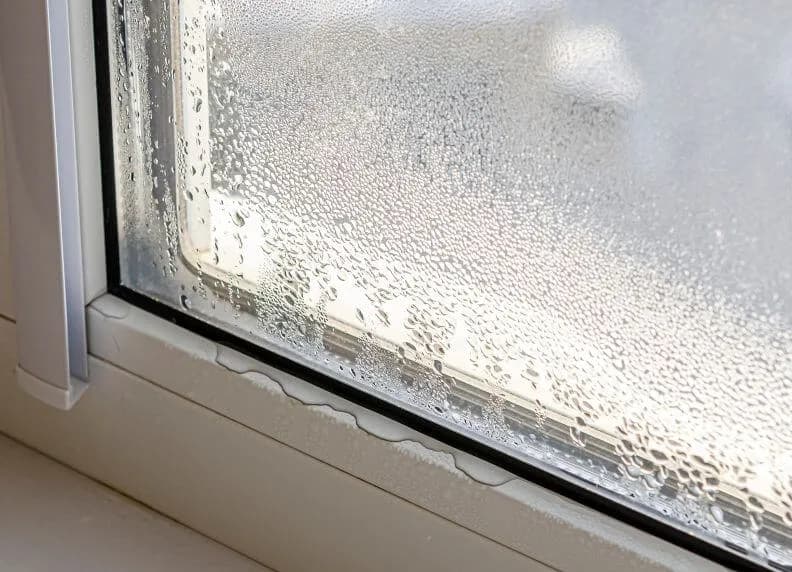
“There is mist on my windows” sounds like one problem. In practice, it can describe three different phenomena: condensation on the room-side surface, dew on the outer surface, or moisture trapped between the panes.
They can look similar, but they arise for different reasons and lead to very different decisions.
The first question should therefore not be “what is wrong with the window?”, but: which side of the glass is the moisture on?
Three locations, three different clues
Condensation on the inner surface of the glass. If droplets are on the room side and can be wiped away, this is surface condensation. It appears when the glass surface becomes cool enough for the dew point of the indoor air to be reached.
This is not automatic evidence of a faulty window. Indoor humidity, the glass surface temperature, ventilation and the conditions immediately around the window all matter.
Condensation on the outer surface of the glass. If moisture can be seen and wiped from the outside, it may be natural external condensation. This occurs when the surface temperature falls below the dew point of the outdoor air. The presence of such dew by itself is not evidence of a window fault.
Condensation between the panes. If mist or droplets are inside the sealed glass unit and cannot be wiped from either the room side or the outside, the situation is different. This points to a loss of seal in the insulated glass unit.
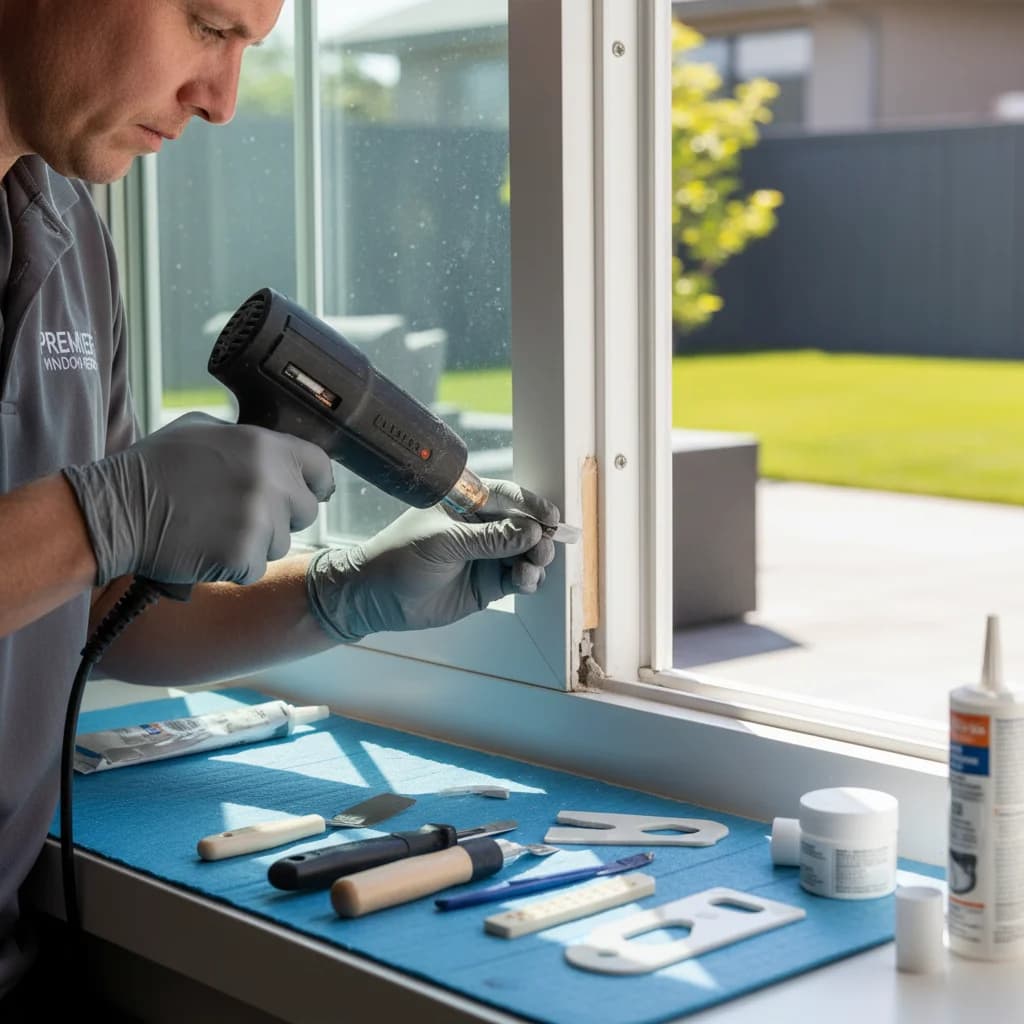
In many window designs the glass unit itself can be replaced if the sash and frame are in suitable condition.
Room-side condensation — humidity and surface temperature both matter
Water does not appear on the glass because the glass “creates” moisture. Water vapour already present in the air condenses when it reaches a sufficiently cool surface.
At least two parameters therefore matter at the same time: the amount of moisture in the air and the temperature of the glass surface. Conditions around the window also play a role, including air exchange and the flow of warm room air near the glass.
Cooking, bathing, drying laundry and simply having people in the room all add water vapour to indoor air. As humidity rises, the dew point changes and condensation can form on a warmer surface than it would in drier air.
Room-side condensation is not automatic proof of a window fault, but it should not automatically be blamed on ventilation alone either.
Why can two windows in the same home behave differently?
This is a useful way to understand why humidity alone does not explain everything. Two windows in similar indoor conditions do not necessarily have identical glass surface temperatures.
If one pane, or one part of it, is cooler, the dew point may be reached there first. Condensation can therefore appear on one window while another remains dry.
Condensation reflects the relationship between air humidity and surface temperature — not just one of those factors.
What to check when condensation is on the room side
Before assuming that the window itself is the problem, collect a few simple observations:
— whether condensation appears on all windows or only one,
— whether it is constant or mainly appears under certain weather conditions,
— whether it becomes worse after cooking, bathing or drying laundry,
— whether air supply and extraction in the room appear restricted,
— whether curtains, blinds or other items limit air movement near the glass,
— whether moisture is confined to the glass or also appears on the frame, reveal or wall.
These observations do not provide a full diagnosis, but they help distinguish temporary indoor conditions from a problem that deserves closer investigation.
Trickle vents can support air supply where the ventilation system needs controlled incoming air. They are not, however, a universal cure for condensation.
If several factors are involved at the same time — for example high humidity, low surface temperature and poor air exchange — fitting a trickle vent alone does not address all of them.
More about how they work is available in our guide to window trickle vents.
Moisture between the panes — here the issue really is the glass unit
Moisture inside a sealed insulated glass unit is different from condensation on its surface. If the mist or droplets cannot be wiped from any accessible side of the glass, that points to a loss of seal in the unit.
The visibility of the symptom may change with temperature and humidity, but the underlying cause does not disappear as a result. Sash adjustment or replacement of perimeter seals will not restore the seal of the glass unit because they concern different parts of the window.
In many window designs the glass unit can be replaced without replacing the whole window, provided the sash and frame are in suitable condition.
More practical detail is available in our article on moisture between the panes. If replacement is needed, see what our glass unit replacement service covers.
Dew on the outer glass — why it can appear on a sound window
The outer surface of the glass can also cool below the dew point of the surrounding air. When that happens, moisture condenses on the outside of the pane, just as dew forms on other cool surfaces.
Dew on the external glass alone is therefore not evidence of a faulty window. It may appear only under certain weather conditions and disappear as temperature, sunlight or humidity changes.
What if the frame, reveal or wall is wet?
That is not the same situation as droplets confined to the glass surface. Moisture on the frame, sill, reveal or wall can have several sources and should not automatically be labelled “window condensation”.
The cause may be condensation on a cold part of the building envelope, an issue at the window-to-wall junction, a local leak, water ingress or another building-related problem.
In that situation, do not limit the diagnosis to the glass alone.
A 30-second check: where is the moisture actually located?
1. Can you wipe it from the room side?
That points to condensation on the inner glass surface.
2. Can you wipe it only from outside?
That points to condensation on the outer glass surface.
3. Can you reach it from neither side?
Moisture may be inside the insulated glass unit.
4. Is the water mainly on the frame, sill or wall?
Do not restrict the diagnosis to the glass.
This is not a complete diagnosis, but it is a very useful first step.
When the problem deserves a closer look
Not every droplet on glass requires a service visit. A closer assessment makes sense when:
— mist or droplets are between the panes and cannot be wiped away,
— room-side condensation is heavy or regularly returns even after indoor conditions have been checked,
— moisture also appears on the frame, sill, reveal or wall,
— local air movement can be felt around a closed window,
— it is not clear which side of the glass the moisture is on.
If the issue concerns the window itself or the insulated glass unit, its condition can be assessed as part of a window diagnosis. If the symptoms point instead to ventilation or the building envelope, window repair alone may not be the right solution.
What is worth remembering
Condensation on windows is not one single fault. First establish where the moisture is: on the room side, outside, or between the panes.
On the room side, the relationship between indoor humidity and glass surface temperature matters. Between the panes, the symptom points to a loss of seal in the glass unit. Outside, dew may simply result from weather conditions.
The key rule is simple: do not diagnose the cause from the presence of water alone — first establish exactly where that water has appeared.
For a closer look at specific scenarios, see our guides to moisture between the panes and window trickle vents. The initial diagnosis and technician’s visit are free of charge.
Related content
See also: Gasket replacement. Initial diagnosis and travel are free of charge.