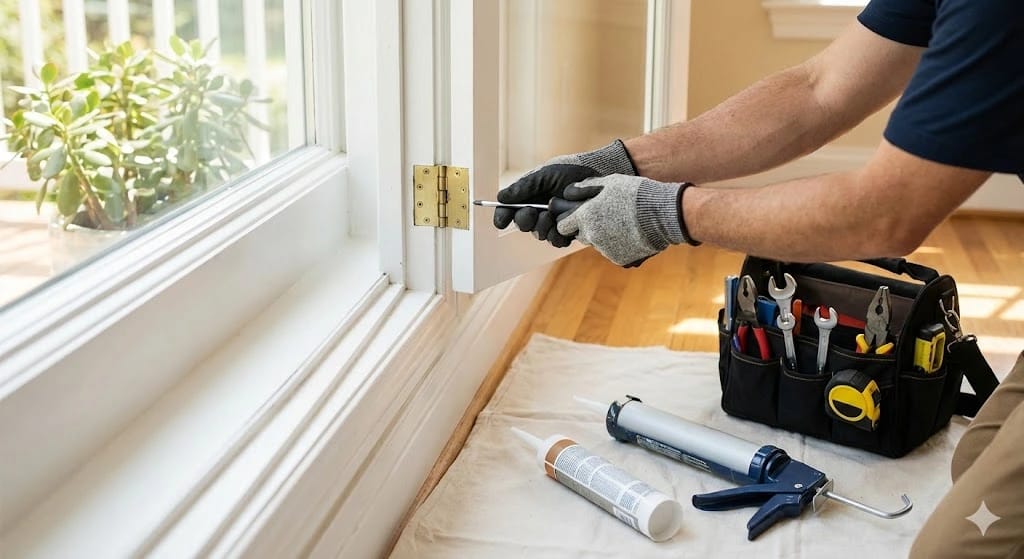
In a wooden window, the same symptom may come from the condition of the coating, the timber itself, the hardware, seals or sash alignment. Before repair, it is therefore useful to separate what can be seen from what is actually causing the problem.
A rubbing sash does not automatically mean wood should be sanded away. A draught does not prove the seal is worn, and surface discolouration does not show how deep damage goes.
With a wooden window, you do not repair the symptom alone — first establish whether the problem concerns the surface, the mechanics or the structure of the wood.
Swelling, hardware or sash alignment?
Wood responds to changes in humidity, so the dimensions of components can change slightly with conditions. If a sash starts rubbing after a period of higher humidity, that is a useful diagnostic clue — but not proof that swelling is the sole cause.
Sash alignment, hardware and the exact location of the rubbing also need to be checked. Several effects may occur at the same time.
Note:
— whether the problem changes with conditions or season,
— whether the sash rubs in one place or several,
— whether the gap around the sash is even,
— whether the window still closes and locks correctly,
— whether the problem appeared suddenly or developed gradually.
The timing of the symptom helps narrow the diagnosis, but does not identify the cause on its own.
Do not sand the wood just because the sash has started rubbing
If the sash began rubbing after a period of high humidity, sanding or planing the rubbing area too quickly can be a mistake. If part of the dimensional change is related to conditions, the sash may change dimensions again when those conditions change.
Removed material cannot be put back. Before working on the timber, first establish whether the issue really comes from its dimensions or from sash alignment or hardware.
Find the cause of the rubbing first. Only then decide whether the wood needs to be altered at all.
Protective coating: judge its condition, not its age
Paint, lacquer or stain reduce the direct effect of external conditions on timber. The need for renovation is therefore better judged from the condition of the surface than only from the number of years since the last coating work.
The coating is continuous and well adhered. There are no clear cracks, flaking areas or exposed timber. Continued observation and maintenance are the main priorities.
The coating is cracking, flaking or locally exposing the wood. This shows that the protective layer needs renewal. The scope depends on the condition of the surface underneath.
The timber beneath the coating is damaged. If there are losses, deeper cracks, deformation or the material has become soft or brittle, renewing the coating alone may not be enough.
The key question is not “how old is the coating?”, but “is it still protecting the timber effectively, and what condition is the material underneath?”.
More about surface care is available in our guide to wooden window maintenance.
Maintenance, renovation and repair are not the same thing
Maintenance is mainly about keeping a functioning window and its coating in good condition.
Renovation restores a surface or coating that has started to deteriorate.
Repair removes a specific fault — for example an issue with hardware, fixing, sealing or a damaged area of material.
Replacement becomes one option when the damage is extensive enough that repair does not provide a reasonable result for the whole window.
Seals and hardware: check the whole system, not just one part
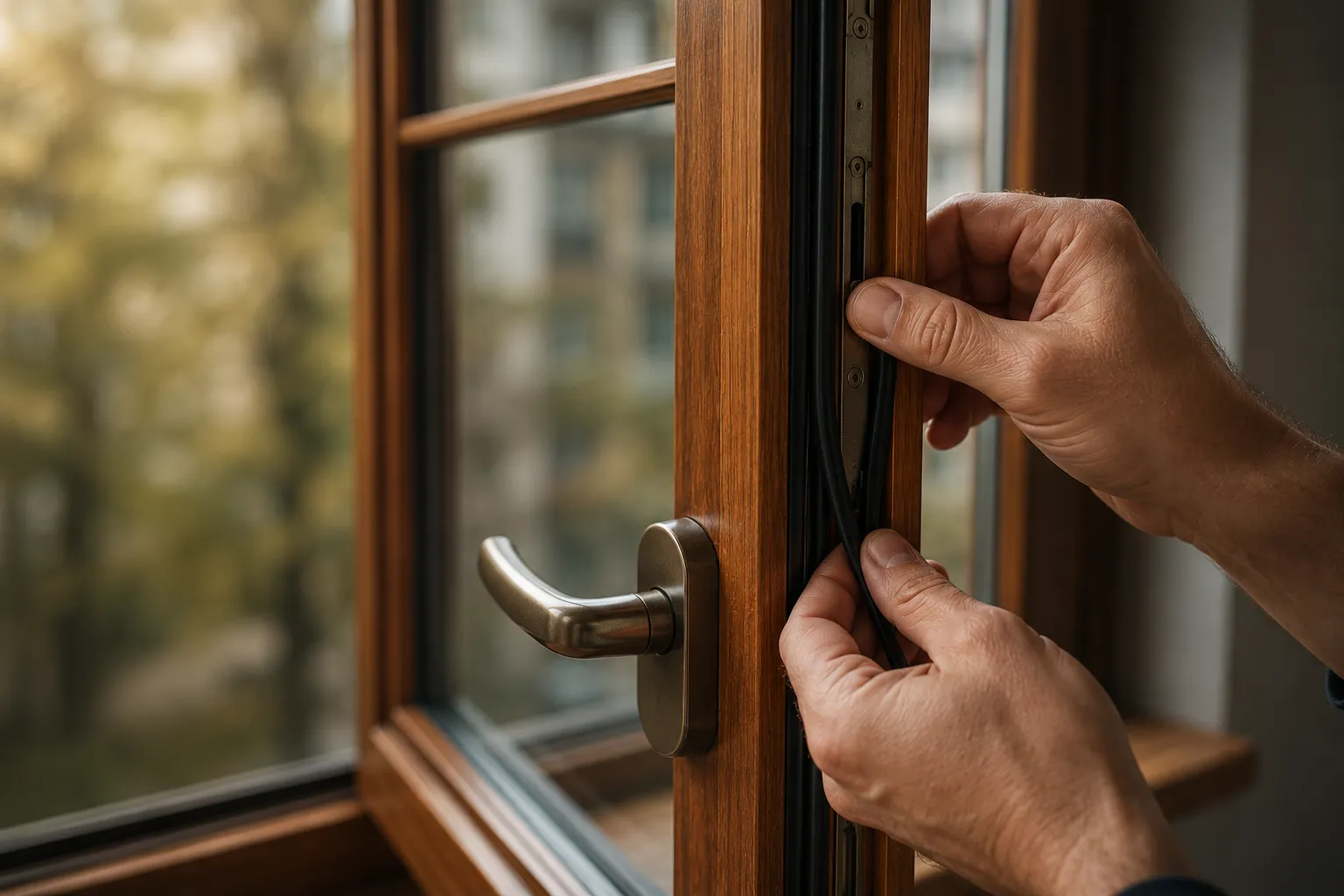
A draught with the window closed may relate to the seal, but the presence of cool air alone does not prove that seal replacement is needed. Compression, sash alignment and the actual location of the leak also need to be checked.
Seal replacement should not be the first step simply because the window feels draughty.
In a wooden window, the condition of the timber where hardware is fixed matters as well as the condition of the hinge or fitting itself. If a fixing has become loose, check whether the surrounding material still provides stable support before repair.
The issue is therefore not only the condition of the hardware, but also the condition of the place where it is fixed.
When the problem really reaches the timber
Damage to the coating and damage to the wood itself are different situations. Cracked paint or stain does not automatically mean the component has lost structural strength.
More attention is needed where there are visible losses, deep or widening cracks, deformation, or wood that has become clearly soft, brittle or weakened.
Discolouration alone does not show how deep the problem goes. More important is whether the wood has retained hardness and stability and whether other signs of damage are present.
A local problem may be suitable for local repair or a larger renovation. With wider damage, assess not only the visible loss but also the condition of the surrounding material.
If moisture marks or damage appear where the window meets the building, do not automatically attribute them to the frame itself. First establish whether the source lies in the window, its installation or the surrounding building element.
A problem at the window-to-wall junction is not by itself an argument for replacing the window.
Repair or replacement? Assess the condition of the whole window
The replacement decision should not be based on one symptom. First establish the true extent of the problem and what condition the whole window will be in after repair.
1. Is the damage local?
A local fault in the coating, hardware, sealing or a small area of timber does not automatically mean the whole construction is affected.
2. What condition is the material around the damage in?
A local repair makes sense only when it can be carried out on a stable base. The surrounding wood matters as much as the visibly damaged area.
3. What will remain after the repair?
If removing one fault leaves the window able to close, seal and operate correctly, repair may be a rational option. If several other important issues remain, the wider work scope needs to be assessed.
4. Does the problem return despite a correctly completed repair?
A recurring fault is first of all a reason for diagnosis again. Only after the cause is understood can another repair be judged properly.
Damage to one area of timber does not automatically mean the whole window needs replacing. But the fact that a local repair is possible does not automatically mean that repair solves the problem of the whole construction.
When choosing between a larger repair and replacement, compare not only the cost but primarily the outcome each option will leave behind. Cost comparison only becomes meaningful once the expected results are comparable.
What you can check yourself — and what not to do immediately
You can:
— inspect the coating and note cracked or flaking areas,
— identify exactly where the sash rubs,
— observe whether the problem changes with conditions,
— check where a draught is felt with the window closed,
— photograph damage and compare its condition over time,
— check whether the window still closes and locks correctly.
Do not immediately:
— sand or plane timber simply because the sash rubs,
— cover soft or damaged wood with a new coating,
— repeatedly adjust hardware to compensate for an unidentified cause,
— fill deeper losses before assessing how far the damage extends.
With a wooden window, a rushed repair can hide the symptom instead of removing the cause.
When to arrange service — and when not to delay diagnosis
Arrange service when:
— the sash constantly rubs or requires increasing force to close,
— there is a clear draught with the window closed,
— the coating has started to crack, flake or expose timber,
— a hardware fixing has become loose,
— the same problem keeps returning.
Do not delay diagnosis when:
— the wood is clearly soft, brittle or losing material,
— water is actively entering the interior,
— the window cannot be closed or locked correctly,
— the sash or a hardware fixing has become unstable,
— the damage is increasing quickly.
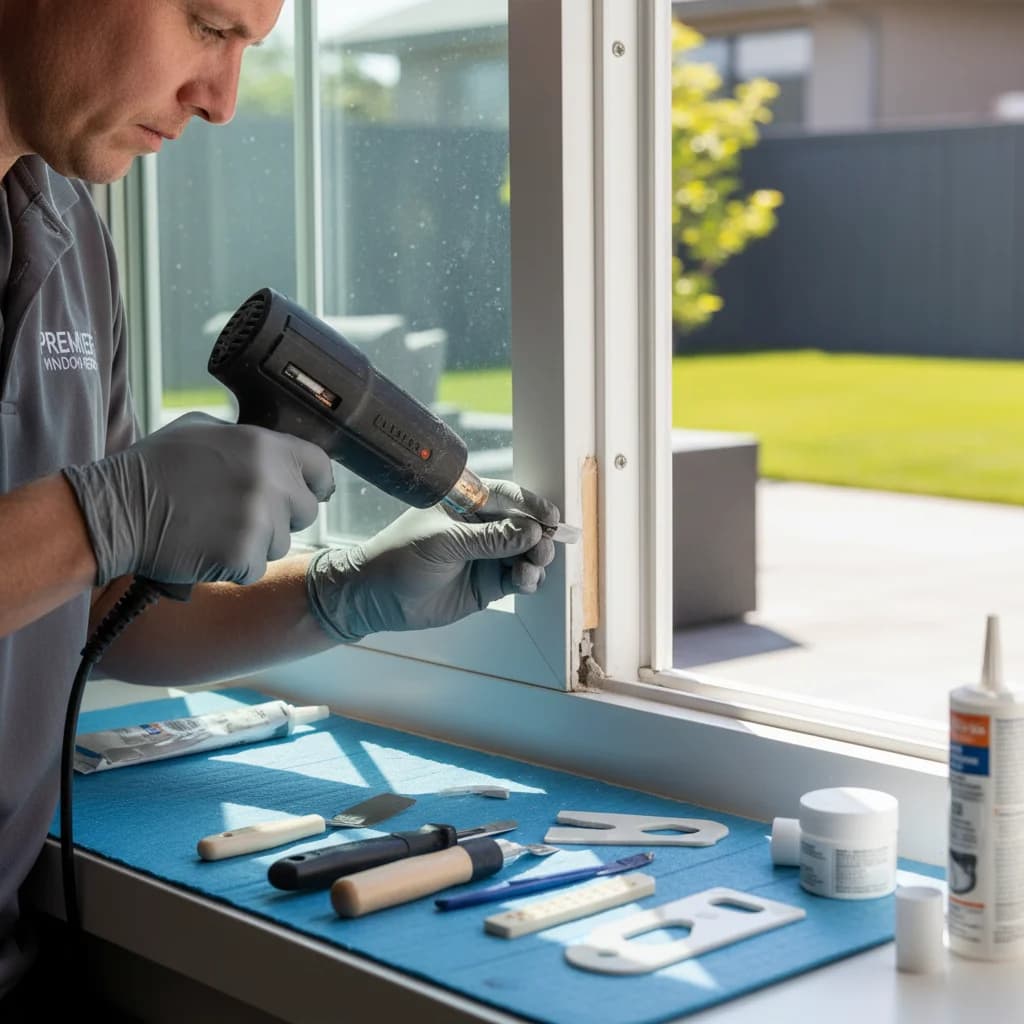
As part of our window repair service, we first establish which part the problem really concerns and the condition of the material around it. Only then can a sensible repair scope be defined.
The initial diagnosis and technician's visit are free of charge. Before work starts, we explain the repair scope and cost.
The key point: define the problem before defining the repair
With a wooden window, it is easy to react directly to the symptom: sand a rubbing area, replace a seal when there is a draught, or cover a damaged surface with a new coating. Such work only makes sense when it addresses the actual cause.
First separate the condition of the coating, the mechanics and the timber itself, then assess the extent of the problem. Only then does it make sense to choose between maintenance, renovation, repair and replacement.
With a wooden window, it matters not only what is damaged but also the condition of the material around that damage — because that determines whether the repair has a stable foundation.
Related services
Timber window service can include wooden window repair, adjustment and gasket replacement. For coating and care guidance, see how to care for wooden windows. Initial diagnosis and travel are free of charge.