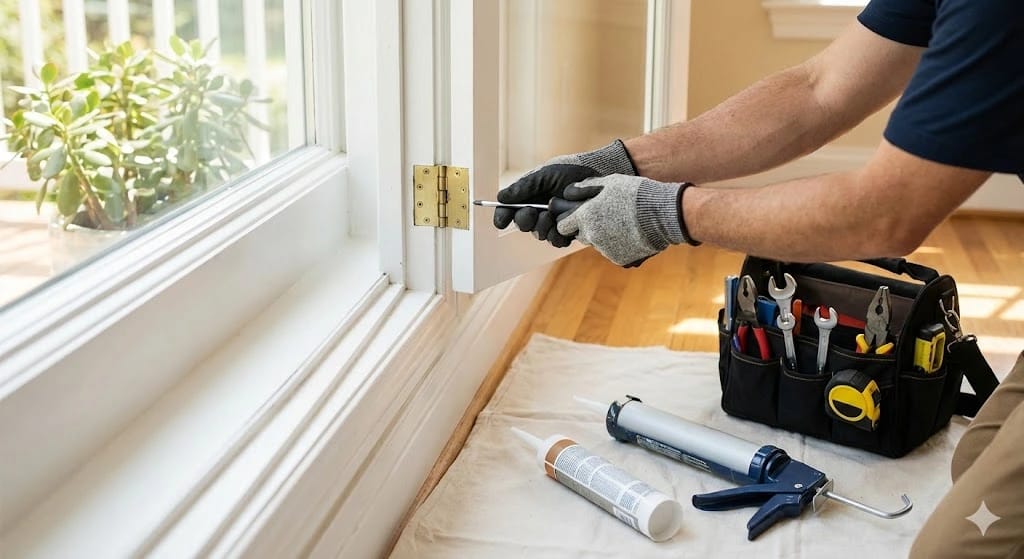
Feeling cold near a window does not always mean that the window is leaking air. In some cases cold outdoor air is genuinely entering through a gap, while in others there is no clear airflow and the discomfort comes from a colder glass surface or another part of the window.
Before replacing a gasket, adjusting the hardware or sealing the window-to-wall joint, first identify what type of problem is actually present. Four common areas worth checking are the gasket, sash alignment and hardware, the window-to-wall connection and the insulating glass unit. They are useful starting points, not an exhaustive list of every possible cause.
Is there a draught, or does the area near the window simply feel cold?
You can feel clear air movement
If there is a draught from the window and the airflow can be located, check the sash-to-frame contact, gasket condition and seating, hardware operation and the frame-to-wall joint. The location of the draught is useful information, but it does not identify a single failed component on its own.
A draughty window may have a gasket problem, sash alignment issue, hardware problem or leakage at the installation joint. Randomly increasing compression or adding extra sealing materials is therefore not a reliable first step.
There is no draught, but the glass area feels noticeably colder
If no clear airflow can be identified and the discomfort is mainly felt near the glass surface, the inner glass temperature may simply be lower than the surrounding wall temperature. Even an airtight window can have a colder interior glass surface, and older or lower-performing glazing can make the area feel less comfortable.
This distinction matters because cold glass alone does not prove that an insulating glass unit has failed, and it does not automatically mean that adjustment or gasket replacement will solve the problem.
4 common causes of cold around a window
1. The gasket is not making proper contact
A gasket may need attention if it is cracked, has missing sections, has come out of its groove, is permanently deformed or does not sit correctly when the sash is closed. Judging softness or hardness by touch alone is not enough to decide that it needs replacing.
Gasket replacement makes sense when the gasket's actual condition or fit is the source of the problem. A new gasket will not fix a draught caused by sash alignment, hardware or the installation joint.
2. The sash is not closing correctly against the frame
Uneven sash-to-frame contact can be related to sash alignment, hinges, locking points or other hardware components. Some systems allow gasket-compression adjustment, but the method and adjustment range depend on the specific hardware system.
Adjustment is appropriate when diagnosis points to sash alignment or hardware interaction. There is no single universal “winter setting” that should be applied to every window.
3. There is a problem at the window-to-wall joint
If airflow is felt along the perimeter of the frame, near the sill or around the reveal, the window-to-wall joint should also be considered. This symptom does not identify which layer or material needs repair.
Adding silicone to the visible edge is not automatically a repair of the installation joint. The actual leakage path and the existing joint construction should be assessed first.
4. The discomfort is related to the glazing
An insulating glass unit can be fully sealed and still perform less efficiently than newer glazing. An older unit without a modern low-emissivity coating is not necessarily damaged; it may simply have a higher U-value and a colder room-side glass surface.
A failed glass-unit seal is a separate issue. Fogging or droplets genuinely trapped between the panes are a typical sign of seal failure and a reason to assess the unit. Cold glass on its own is not enough to make that diagnosis.
What can you check yourself without dismantling the window?
Where exactly can you feel air movement?
Note whether airflow is felt between the sash and frame, along the outer edge of the frame, near the sill or somewhere else. If the area feels cold without clear air movement, the temperature of the glass surface should also be considered.
What does the gasket condition show?
Look for cracks, missing sections, areas that have come out of the groove and permanent deformation. These signs can justify closer inspection, but softness, hardness or flattening alone do not provide a reliable diagnosis.
Does the paper test tell you anything useful?
A sheet of paper can help compare resistance at different points around the same window, but it does not measure compression force and cannot identify the cause of a leak by itself. The result depends on the gasket design, locking-point positions and sash alignment.
What does fogging between the panes mean?
If fogging or droplets are genuinely trapped between the panes and are not on any accessible glass surface, this is a typical sign that the insulating glass unit has lost its seal. Condensation on the room-side or exterior surface is a different issue.
How should the repair be matched to the cause?
Sash alignment or hardware problem
If diagnosis points to sash alignment or the way the hardware operates, adjustment may be appropriate. The available adjustment depends on the particular system and should not be chosen simply because the season has changed.
Worn or damaged gasket
If the gasket is damaged, permanently deformed or unsuitable for the window, replacement with the correct gasket for the specific profile and window construction may be appropriate.
Leakage at the window-to-wall joint
If the installation joint is the source, its construction and the actual leakage path need to be assessed before a suitable repair method and materials are chosen.
Failed insulating glass unit
If loss of seal is confirmed, the standard solution is replacement of the complete insulating glass unit. Replacing the whole window is not automatically necessary when the frame, sash, hardware and glazing system remain in suitable condition.
The whole window is in poor condition
Full window replacement may be worth considering when serious damage affects the overall construction rather than one isolated component — for example when the frame or sash is permanently deformed, or when several independent repairs are no longer technically or economically sensible.
Maintenance can help prevent problems, but it is not a substitute for repair
Periodic hardware maintenance and gasket care can help keep serviceable components in good condition when carried out according to the manufacturer's instructions. They should not, however, be treated as a repair for every cause of cold around a window.
Lubricating hardware will not repair a cracked gasket or a leaking window-to-wall joint. A gasket maintenance product will not restore a component that is cracked, permanently deformed or incorrectly matched. A failed insulating glass unit cannot be restored through routine maintenance either.
What should you avoid when there is a draught?
Do not add random self-adhesive foam tape. A universal tape is not automatically a substitute for the gasket designed for the specific system and can change the way the sash closes without addressing the actual leakage path.
Do not apply silicone at random. Additional sealant can hide the real source of the problem and, if applied in the wrong place, may also cover drainage openings designed into the window.
Do not increase compression to the maximum. More compression is not a universal solution for cold or draughts and can place unnecessary load on the gasket and hardware.
Cold around a window and heat loss — what can actually be assessed?
Heat loss through windows depends on many factors, including glazed area, glazing and frame performance, airtightness, installation quality, temperature difference and the rest of the building envelope. Feeling cold near a window does not allow a reliable estimate of what percentage of a heating bill is caused by that particular window.
A more precise assessment requires information about the window and building construction and, in some cases, measurements. Universal percentages assigned to every “cold” window are therefore not reliable.
Window insulation — what actually makes sense?
The term window insulation is used online for very different interventions: adjustment, gasket replacement, repair of the installation joint, glazing upgrades or other work around the window.
There is no single universal “window insulation” procedure. The correct solution depends on whether the problem is airflow, gasket condition, sash alignment, the window-to-building connection or simply the thermal performance of an otherwise serviceable glass unit.
Can a cold window contribute to condensation?
Condensation forms when a surface temperature reaches the dew point or falls below it for the humidity level in the air. A colder glass surface can therefore increase the likelihood of condensation, but indoor humidity, ventilation and outdoor conditions also matter.
Prolonged dampness can encourage mould growth. Improving the thermal performance of a window can, in some situations, raise the room-side glass temperature and reduce the risk of condensation, but indoor humidity and ventilation still need to be assessed separately. For related guidance, see our articles on cold air from a window and condensation and moisture on windows.
When is professional diagnosis worth arranging?
Professional assessment is useful when a draught repeatedly appears in one location, the sash rubs or does not close correctly, the gasket has visible damage, fogging is genuinely trapped between the panes, leakage is suspected around the frame-to-wall joint, or it is difficult to distinguish a draught from discomfort caused by a cold glass surface.
As part of our window repair service, the scope of work is matched to the condition of the individual window. The initial diagnosis and technician's visit are free of charge.
In short
Feeling cold near a window does not always mean air leakage and does not always call for the same repair. Clear airflow directs attention to the gasket, sash alignment, hardware or installation joint. Cold glass without a draught may reflect glazing performance, while fogging between the panes is a typical sign of a glass-unit seal problem.
The best sequence is not to move from the cheapest repair to the most expensive, but from the symptom to the correct diagnosis.