Smog in Kraków complicates something as simple as airing a home. Indoor air still needs to be exchanged and excess moisture and CO₂ need to be removed, but when outdoor particle concentrations are high, opening windows increases the amount of polluted outdoor air entering the home. There is therefore no single rule such as “air frequently” or “never open windows in winter”.
When outdoor air quality is poor, current measurements and official guidance should determine how much you open the windows, while the home's ventilation should be considered as a complete system. The window affects airtightness, a trickle vent provides an air-supply path, and the ventilation ducts provide the exhaust path.
Kraków smog and window airing — what is the actual problem?
A home needs air exchange throughout the year, but during a pollution episode the outdoor conditions may be unsuitable for routine window airing. The question is therefore not simply whether to ventilate or never ventilate, but how to manage air exchange in line with current outdoor conditions and the building's ventilation system.
Outdoor air quality can change during the day, so window opening should not be based only on a fixed time of day or a habitual schedule. Current measurements and official alerts are a better reference.
When should you air a home during smog?
Check current outdoor air quality
Before opening windows, check the current air-quality index and particulate levels using an official monitoring source. If an alert recommends limiting indoor airing, follow that recommendation.
Limit window opening when pollution levels are high
When outdoor pollution is high, there is no good basis for a fixed rule such as “shorter but more frequent airing”. Every opening increases exchange with outdoor air, so window airing should be reduced in line with current guidance and the way the building's ventilation system operates.
Use periods when air quality improves
If current readings are clearly better and there is no recommendation to limit airing, opening the windows can be considered. There is no single number of minutes that suits every home; room size, occupancy and ventilation performance all matter.
Airtight windows and home ventilation
What changes when old windows are replaced with airtight ones?
More airtight windows can reduce uncontrolled infiltration that previously occurred through gaps. In a building with natural ventilation, this can change the amount of outdoor air entering the rooms, so the whole ventilation arrangement should be considered rather than the window's airtightness alone.
Airtightness itself is not a defect. The problem arises when the ventilation system relies on outdoor air supply and no adequate inlet path is provided after the building envelope becomes tighter.
What is the role of a trickle vent?
A trickle vent is an air-supply component that allows outdoor air to enter without fully opening the window. It does not replace the route by which stale air leaves the home. In natural ventilation, both an adequate air inlet and a functioning exhaust path are needed.
Filtered trickle vents — what can they do, and what can they not do?
Control method and filtration are two different things
Terms such as humidity-controlled, pressure-controlled or manually controlled describe how airflow is regulated. Filtration is a separate characteristic of the specific product. A vent that responds to indoor humidity does not automatically provide a defined level of particle filtration.
A filter does not automatically mean PM2.5 protection
The statement that a trickle vent has a filter is not enough to determine its effectiveness against PM2.5 or PM10. What matters are the declared performance of the specific filter, the particle range covered by those claims, the required airflow and the condition of the filter in use.
If reducing particle ingress is the goal, check the technical documentation for the specific model rather than relying only on labels such as “anti-smog” or “filtered”.
When can a filtered trickle vent make sense?
It can be one part of the solution if it is compatible with the building's ventilation system, provides the required air supply and has filter performance suited to the intended purpose. Airflow resistance and filter cleaning or replacement requirements also need to be considered.
We explain the general operating principles and selection criteria in our guide to window trickle vents.
What does a trickle vent not replace?
A trickle vent does not replace exhaust ducts or a complete ventilation system. It should not automatically be treated as a substitute for an air purifier either; the two serve different functions. A trickle vent primarily provides a controlled path for outdoor air to enter, while its filtration performance depends on the specific design.
Condensation on windows — are airtight windows to blame?
Why does condensation form?
Condensation forms when the temperature of the glass or another surface falls below the dew point of the indoor air. The higher the indoor humidity and the colder the surface, the easier it is for water vapour to condense.
Droplets on the room-side surface of the glass are therefore not, by themselves, proof that the window is leaking or damaged.
What role does ventilation play?
Insufficient air exchange can contribute to higher indoor humidity and therefore increase the risk of condensation. It is not the only possible cause; surface temperature, moisture generation inside the home and thermal conditions around the window also matter.
When might the problem involve the window itself?
The window should be checked if condensation appears together with other symptoms such as a noticeable draught, difficulty closing, gasket damage, or misting between the panes of the insulating glass unit. Misting inside the glazing unit is a different problem from condensation on the room-side glass surface.
We explain these differences in more detail in our guide to condensation and moisture on windows.
What can you check yourself at the window?
Gasket condition
Check whether the gaskets are correctly seated and whether there are visible cracks, missing sections, areas that have come out of the groove or obvious deformation. The colour of surface deposits or gasket hardness alone is not enough to decide that replacement is needed.
Cleanliness of accessible components
Accessible frame surfaces, gaskets and manufacturer-designated maintenance points can be cleaned according to the manufacturer's instructions. Ordinary airborne deposits should not be treated as proof of a specific hardware fault without other symptoms.
Trickle vent operation
If the window has a trickle vent, check that it is not blocked and follow the manufacturer's instructions for cleaning, filter servicing or filter replacement. In filtered units, filter condition affects both airflow and the filtration performance stated by the manufacturer.
When is the problem with the window, and when is it the ventilation?
The window itself is worth checking when the sash rubs against the frame, the window is difficult to close, the gasket is damaged, the hardware shows an obvious fault, there is misting inside the insulating glass unit, or there is an uncontrolled draught around the window.
If the issue is persistent humidity in several rooms, inadequate air exchange or the operation of ventilation ducts, window repair alone may not address the cause. Not every indoor-air or moisture problem is a window defect.
If the window itself is suspected, the cause should be identified first and the scope of work chosen afterwards. The initial diagnosis and the technician's visit are free of charge.
Smog, windows and ventilation in Kraków — key takeaways
When outdoor pollution is high, follow current alerts and limit window opening when that is the recommendation. An airtight window does not replace ventilation; a building needs both an air-supply path and a way for stale air to leave. A filtered trickle vent can be one part of the solution, but its effectiveness depends on the specific product and filter performance. Condensation or damp does not automatically mean the window has failed — the source of the problem should be identified first.
When smog concerns overlap with the condition of the window
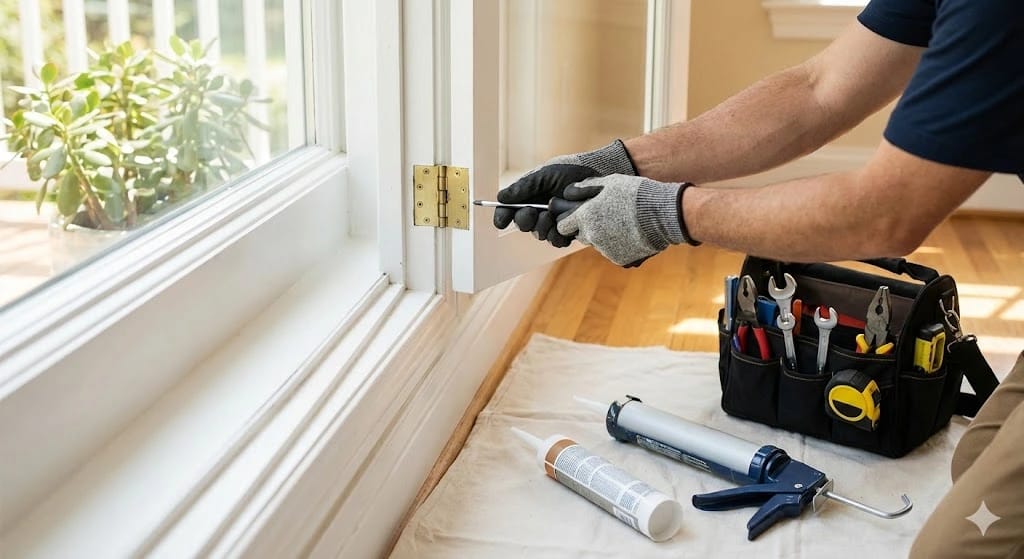
If the issue concerns the window itself, local service options are described under window repair in Kraków. A damaged or permanently deformed gasket may require gasket replacement, while a problem caused by the position of otherwise serviceable components may call for window adjustment. These are repairs to the window, not methods of filtering smog. Controlled air supply and the mechanical condition of the window should be assessed as separate issues.